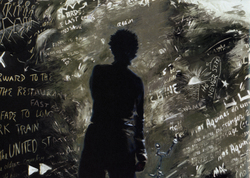
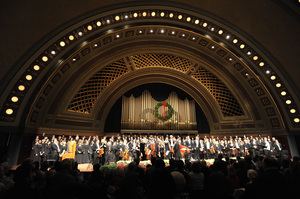
The expression "Blues at the CrossRoads" obviously has two separate meanings. This clever title for the event referred simultaneously, I suppose, to both the past and the present of the blues. On the one hand, given that the event was a tribute to the great delta bluesman Robert Johnson, the "crossroads" of the title was a reference to the celebrated mythology that has grown up around Johnson: that he is reputed to have met the devil at the crossroads and struck a bargain with him, dying early in exchange of acquiring the ability to play the guitar so prodigally in such a short period of time. (Here is Ann Arbor's own John Sinclair performing his poem "The Crossroads" about this legend -- although John Sinclair wasn't part of the HIll Auditorium event, blues and Ann Arbor cannot be mentioned in the same breath without thinking immediately of John Sinclair!) But "crossroads" also have another meaning; they represent possibility and choice, the ability to veer off into a new direction. A concert that gives itself over to celebrating "blues at the crossroads", then, signals through its very title that it is interested not so much in preserving the music as if it were frozen in time, as it is in being open to new directions and possibilities even as it pays homage to the past.
This dual celebration of old tradition and new possibility was well expressed in the roster of the event's musicians. On the one hand, there were the canonical bluesmen, grand old men of the tradition, its legends: the 95-year-old David "Honeyboy" Edwards and the 79-year-old Hubert Sumlin. On the other hand, there were also Todd Mohr (of Big Head Todd and the Monsters), the guitarist Steve "Lightnin' " Malcolm and the drummer Cedric Burnside, the grandson of the great Mississippi bluesman R.L. Burnside. While several blues standards associated with Robert Johnson -- such as (of course) Crossroads Blues, were interpreted by the evening's performers, and such blues standards as Johnson's "Sweet Home Chicago" were sung, there was also ample room, especially by the likes of Todd Mohr and his bandmates Squires, Nevin and Lawton, for a more contemporary, experimental, rock-music-inspired blues sound as well. (Interestingly, the review of the event by annarbor.com is scathingly critical of this aspect of the concert, opining that the insertion of a more contemporary sound into the event represented a lack of authenticity. I disagree -- I think it is much more interesting to "mix it up" as the event did, to have the old and the new sound share the stage and rub shoulders, so to speak.)